

Xenoame Laboratory
Overview
The mission of Xenoame Laboratory is to empower Xenoame and its creators by streamlining development processes and reducing operational workload through the use of Xelab AI. By providing advanced, automated, and procedural AI and Non-AI driven solutions, Xenoame Laboratory aims to enhance productivity, accelerate creative workflows, and enable the organization to focus on innovation while relying on intelligent automation for repetitive or complex tasks.
Xenoame Laboratory serves as the research and development foundation responsible for the model architecture, training pipelines, and optimization strategies that define Xelab Models.
Xelab AI
Xelab Models (.xelab) are proprietary model formats developed by Xenoame Laboratory. Each model is classified as Generative AI, Procedural AI, or PCG Systems, representing automated, generative, or procedural processes that may operate with or without AI assistance and minimal or without human intervention. In addition to this primary classification, models may be further categorized by functional domain, such as Visual AI, Voice AI, or other specialized applications. Collectively, these models may be referred to as Xelab AI.
All Xelab Models are distributed exclusively in the proprietary .xelab format or embedded within software and games.
Each Xelab Model is designed to balance performance, speed, and scalability. Depending on the model version and design goal, a Xelab Model may or may not include waypoints. This distinction directly affects how the model processes data and how quickly it produces results.
Xelab Output
After the process is completed, users may receive log files. The presence of log files indicates that the model has successfully generated waypoints and serves as the primary reference for that data.
It is strongly recommended that users store and back up these log files. If they are lost, the waypoint data may become permanently inaccessible, potentially preventing the model from functioning as intended.
Regardless of whether a model uses AI or PCG, any process that generates waypoints will always produce log files for reference.
Understanding Waypoints
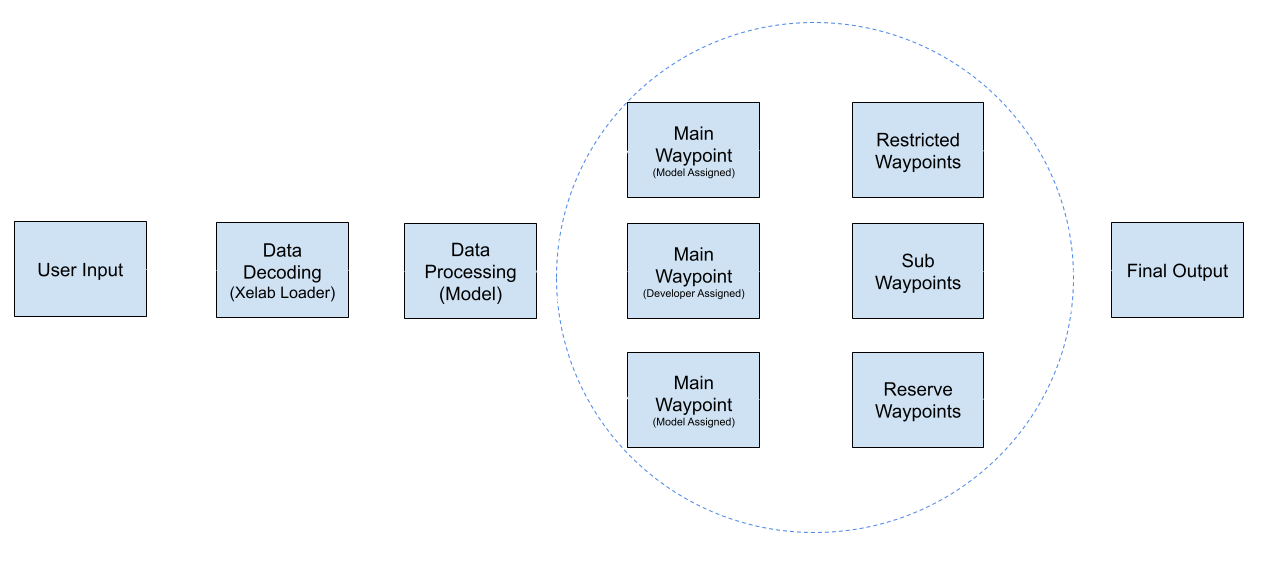
Waypoints function as structured data routing points rather than simple reference markers. During model execution, user input data is passed through specific waypoints in a defined sequence. If the input data reaches the correct waypoint, the model then forwards related data to other corresponding waypoints. This process continues repeatedly until the entire dataset has been read, processed, and validated.
Each waypoint is responsible for handling a specific portion of the data flow. As data moves between waypoints, previously processed chunks do not need to be re read. Instead, the model continues from the last valid processing state. This staged and segmented data handling approach is the core reason why waypoint based models operate significantly faster.
Because large portions of the data are already processed during earlier stages, the model avoids redundant computation. The system does not restart processing from the beginning for each operation. Instead, it advances through the waypoint chain, allowing only the remaining unread or unprocessed data to be handled. This incremental processing method greatly reduces execution time while preserving output accuracy.
This design explains why waypoint enabled models such as Pixilea Pixelization 2.0 can produce results in seconds.
Performance Comparison Example
A clear real world example can be seen in the Pixilea Pixelization model series. Pixilea Pixelization 1.0 does not utilize waypoints. Because of this, image generation may take anywhere from several seconds to several minutes.
Pixilea Pixelization 2.0 introduces waypoint support. With waypoints enabled, generation time is reduced to approximately one to three seconds. The performance improvement is significant and immediately noticeable.
After experiencing Pixilea Pixelization 2.0, returning to version 1.0 becomes impractical due to the speed difference. This highlights the importance of waypoint integration in modern Xelab Models.


Advantages of Using Waypoints
Waypoints drastically improve processing speed. They reduce redundant calculations and allow the model to reuse learned optimization paths. This results in faster output generation and more efficient resource usage.
For complex models, waypoints are essential to maintaining acceptable response times. Without them, large scale models would struggle to meet real time or near real time requirements.
Limitations and Risks
Waypoints function as structured data routing points rather than simple reference markers. During model execution, user input data is passed through specific waypoints in a strictly defined sequence. As the data reaches each correct waypoint, the model immediately begins reading and processing that data, while simultaneously forwarding the appropriate portions to other corresponding waypoints. This process continues until the entire dataset has been fully read, processed, and validated.
Each waypoint is responsible for handling a specific segment of the data flow. As data passes through a waypoint, it is actively read and consumed by the model at that stage. Once a segment has been fully read, it does not need to be read again. The model then continues processing from the last completed state, moving forward through the waypoint chain without restarting earlier stages.
Because the data is read progressively and only once per waypoint, the model avoids redundant reading and computation. The system does not restart processing from the beginning for each operation. Instead, it advances through the waypoint sequence, ensuring that only data that has not yet been read is handled. This continuous, forward only processing model is the primary reason waypoint based systems achieve significantly higher execution speeds.
Best Practices
Always back up log files immediately after they are generated and store copies in multiple secure locations. Treat waypoint data as critical infrastructure rather than optional metadata.
Proper record-keeping ensures the long-term usability of the model and safeguards against irreversible data loss. Within the Xelab ecosystem, managing waypoints is an essential responsibility of the user.